Choosing between an automatic vs mechanical vs quartz vs chronograph watch is one of the most important decisions a watch buyer makes — and one of the most misunderstood. Walk into any watch shop, and you’ll encounter terms like “Swiss lever escapement,” “COSC certified,” “32,768 Hz oscillation,” and “column-wheel chronograph” thrown around as if they’re common knowledge.
They’re not. And that confusion costs buyers money.
This guide is for anyone — first-time buyers, gift shoppers, and seasoned collectors — who wants a clear, honest breakdown of all four watch types, how they work, what they cost, and which one deserves a place on your wrist.
What Is a Mechanical Watch?
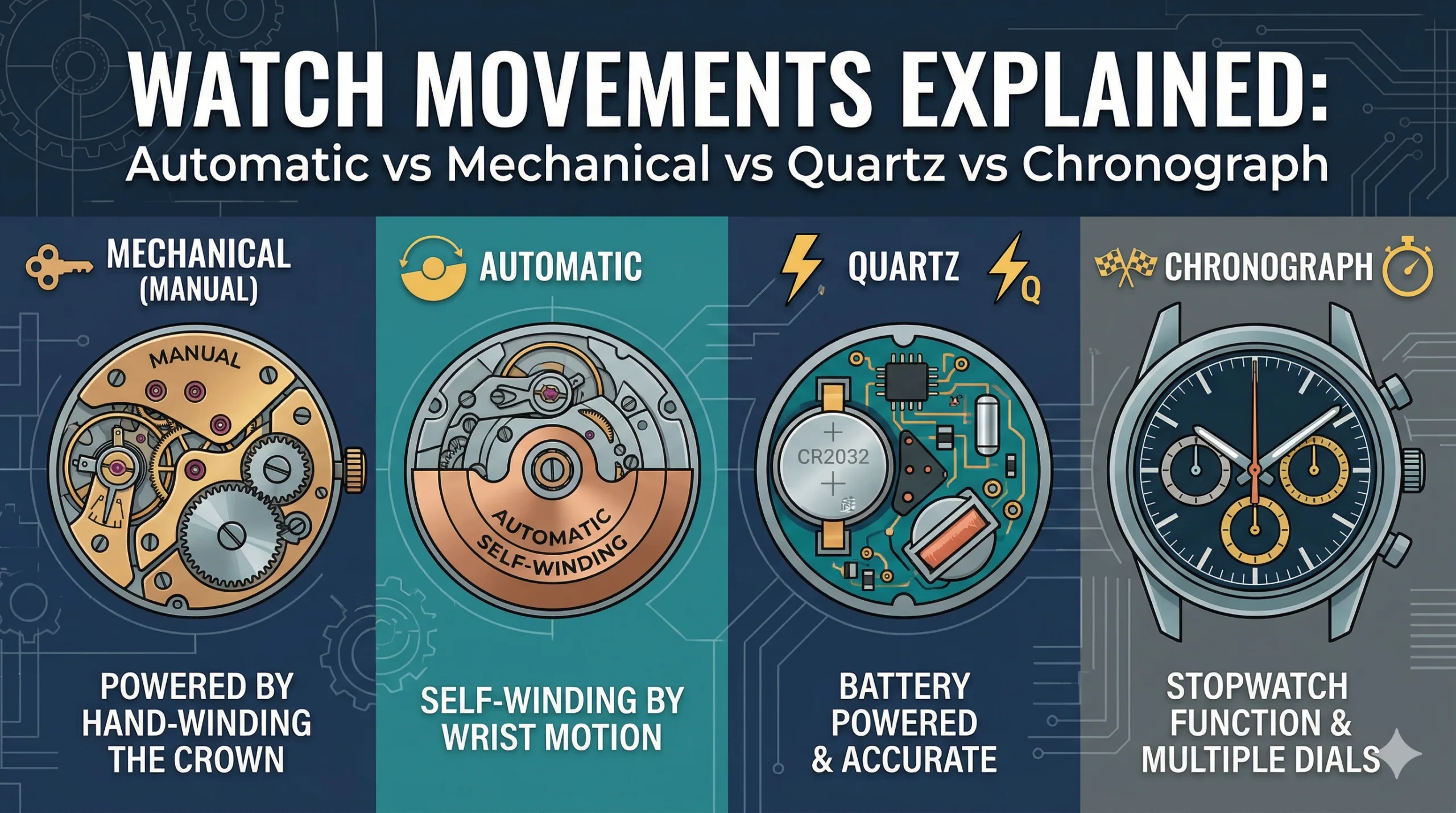
A mechanical watch is powered entirely by a coiled metal spring called a mainspring. When you wind the crown on the side of the watch, you tension this spring. As it slowly uncoils, the stored energy drives a series of gears, levers, and a tiny oscillating wheel called the balance wheel — which regulates the release of energy at precise intervals, producing the characteristic “tick-tock” sound.
How a Mechanical Watch Works (Step by Step)
- You wind the crown — tensioning the mainspring inside the barrel.
- The barrel releases energy through a gear train.
- The escapement (a lever and escape wheel) controls the rate of energy release.
- The balance wheel oscillates at a fixed frequency — typically 18,000 to 28,800 vibrations per hour (vph).
- The hands move, displaying time.
Key Features of Mechanical Watches
- No battery required — ever.
- Entirely hand-wound — must be wound daily or every 1–2 days.
- Power reserve: Most mechanical watches store 36–72 hours of energy.
- Accuracy: Typically ±10–30 seconds per day without regulation; COSC-certified movements achieve ±4 seconds/day.
- Price range: Entry-level from $200 (Seiko 5 series); luxury from $3,000+ (Jaeger-LeCoultre, A. Lange & Söhne, Patek Philippe).
Why Choose a Mechanical Watch?
Mechanical watches are the oldest watchmaking tradition, dating back to the 15th century. For enthusiasts, the appeal is philosophical: a mechanical watch is a self-contained machine — no electronics, no circuits, no digital components. Every component is crafted by hand or CNC-machined to tolerances measured in microns.
Brands like Patek Philippe, A. Lange & Söhne, and F.P. Journe charge anywhere from $10,000 to several million dollars for their hand-wound movements — and collectors actively pay those prices.
Fun fact: The most expensive wristwatch ever sold at auction is the Patek Philippe Grandmaster Chime Ref. 6300A-010, which fetched CHF 31,000,000 (approximately $33.6 million) at a 2019 Christie’s auction.
What Is an Automatic Watch?
An automatic watch (also called a self-winding watch) is a type of mechanical watch — with one key difference: it winds itself. A semicircular metal weight called a rotor is mounted on the movement and rotates freely with the natural motion of your wrist. As your arm moves throughout the day, the rotor spins, winding the mainspring automatically.
How an Automatic Watch Winds Itself
- The rotor pivots 360° in either one or both directions (bidirectional in modern automatics).
- Rotation is transferred via a ratchet or clutch mechanism to the mainspring.
- If you wear the watch for 8+ hours daily, it typically stays fully wound.
- If left unworn for 40–72 hours, it will stop and need a manual wind or a watch winder (a motorized case that keeps it running).
Key Features of Automatic Watches
- Self-winding via wrist motion.
- No battery — ever.
- Power reserve: Typically 38–80 hours; some models like the Seiko Prospex SPB259 offer 70-hour reserves.
- Accuracy: Same as mechanical — ±5–25 seconds/day; COSC-certified automatics achieve ±4 seconds/day.
- Movement thickness: Automatics are slightly thicker than their manual-wind counterparts due to the rotor.
- Price range: Entry-level from $100 (Casio MTP-V004); mid-range $300–$2,000 (Seiko, Orient); luxury $3,000+ (Rolex, Omega, Tudor).
Famous Automatic Movements
| Movement | Brand | Beat Rate | Power Reserve |
| Calibre 3235 | Rolex | 28,800 vph | 70 hours |
| ETA 2824-2 | Various | 28,800 vph | 38–42 hours |
| Miyota 9015 | Citizen | 28,800 vph | 42 hours |
| NH35A | Seiko | 21,600 vph | 41 hours |
| Calibre 8500 | Omega | 25,200 vph | 60 hours |
Why Choose an Automatic Watch?
Automatics Watches offer the artistry of mechanical watchmaking without the daily winding ritual. They are the most popular choice among watch enthusiasts for a reason: you get heritage craftsmanship with practical wearability. The visible rotor (especially on skeleton-dial models) adds a kinetic visual appeal that quartz movements simply cannot replicate.
What Is a Quartz Watch?
A quartz watch uses a battery to send an electric current through a tiny quartz crystal. The crystal vibrates at an extremely precise frequency — 32,768 Hz (oscillations per second) — a rate chosen specifically because it’s a power of 2 (2¹⁵), making it easy to divide electronically down to 1 Hz to drive the seconds hand. These vibrations are converted by an integrated circuit into regular pulses that move the stepping motor and, in turn, the watch hands.
Quartz technology was first commercially introduced by Seiko with the Astron on December 25, 1969 — an event that triggered the “Quartz Crisis,” which nearly destroyed the Swiss watch industry during the 1970s and 1980s.
Key Features of Quartz Watches
- Battery-powered — typical battery life: 1–5 years (standard); up to 10+ years (Citizen Eco-Drive, solar quartz).
- Extremely accurate: ±15 seconds per month (standard quartz); ±5 seconds per year (high-accuracy quartz); ±1 second per year (thermo-compensated quartz like the Grand Seiko 9F series).
- Thinner movements: Quartz can be made far slimmer than mechanical movements — enabling ultra-thin dress watches.
- Low maintenance: Battery replacement every few years; no winding, no servicing every 3–5 years.
- Price range: From $10 (Casio F91-W) to $5,000+ (Grand Seiko Calibre 9F83).
Types of Quartz Watches
- Standard quartz — Battery + crystal; accuracy ±15 sec/month.
- Solar quartz (Eco-Drive, Solar) — Light charges internal capacitor; no battery replacement needed.
- Radio-controlled (atomic) — Syncs via radio signal to atomic clocks; accuracy within ±1 second per 100,000 years.
- GPS quartz — Syncs via GPS satellite; auto time zone correction.
- Thermo-compensated quartz — Temperature sensor corrects crystal drift; ±5 sec/year (Grand Seiko, Breitling SuperQuartz).
What Is a Chronograph Watch?
Here’s where many buyers get confused: a chronograph is not a movement type. It’s a complication — a watchmaking term for any function beyond basic timekeeping. Specifically, a chronograph is a precision stopwatch integrated into a wristwatch, operated by pushers (buttons) on the side of the case.
A chronograph can be built on a mechanical, automatic, or quartz base movement. That means when you buy a chronograph watch, you’re choosing both a complication and a power source — making it one of the most layered purchase decisions in watchmaking.
How a Chronograph Works
A chronograph has three core functions:
- Start — Press the top pusher to begin timing an elapsed event.
- Stop — Press the top pusher again to freeze the elapsed display.
- Reset — Press the bottom pusher to return all chronograph hands to zero.
The elapsed time is typically shown across two or three sub-dials on the watch face:
- A seconds sub-dial (running 0–60 seconds)
- A minutes sub-dial (running 0–30 or 0–60 minutes)
- Optionally, an hours sub-dial (running 0–12 hours)
Types of Chronograph Mechanisms
Mechanical / Automatic Chronograph
The most complex and revered type. A dedicated gear train and lever system (the clutch) engages the chronograph seconds hand when the pusher is pressed. Two dominant designs exist:
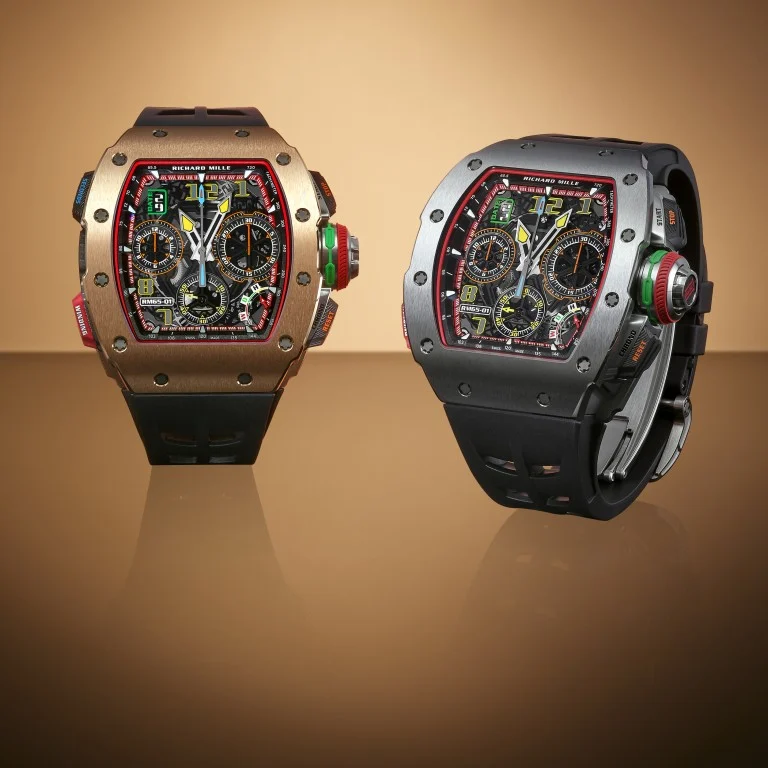
- Column-wheel chronograph: Uses a rotating column-wheel to precisely control the clutch. Smoother action, more reliable, more expensive. Found in Rolex Daytona Calibre 4130, Patek Philippe CH 29-535 PS, Zenith El Primero.
- Cam-and-lever (lateral clutch): Uses a flat cam instead of a column-wheel. More economical to produce. Found in many ETA Valjoux 7750-based movements.
Flyback Chronograph
A high-end variation: pressing the reset pusher simultaneously stops, resets, and restarts the chronograph in a single action — critical for pilots timing sequential legs of a flight. Found in IWC Pilot’s Watch Chronograph, Breitling Navitimer, Longines VHP.
Rattrapante (Split-Seconds) Chronograph
The most complex chronograph variant. Two seconds hands are stacked on the same axis. A third pusher allows one hand to “split” and stop independently while the other continues running — enabling timing of two simultaneous events. Found in Patek Philippe Ref. 5370P, A. Lange & Söhne Double Split.
Quartz Chronograph
Uses an integrated circuit to time elapsed seconds with button-press precision. Accurate to ±1/100th of a second (compared to ±1/8th of a second for mechanical chronographs). Far less mechanically complex, and significantly more affordable. Found in Seiko SSB397, Citizen AT2480-81L, TAG Heuer Formula 1 Quartz.
Key Features of Chronograph Watches
- Complication type: Stopwatch function built into the watch movement.
- Power source: Can be mechanical (hand-wound), automatic (self-winding), or quartz (battery).
- Accuracy of stopwatch function: Quartz ±1/100 sec; mechanical ±1/8 sec per beat.
- Sub-dial layout: 2-register or 3-register (most common); tachymeter scale on bezel common for speed measurement.
- Movement complexity: A mechanical chronograph adds 100–300 additional components to a standard base movement.
- Price range: Entry quartz from $100 (Seiko SSB); mid-range automatic from $500 (Seiko Prospex Speedtimer, Orient); luxury mechanical from $4,000+ (TAG Heuer, IWC, Breitling); ultra-luxury from $30,000+ (Patek, Lange).
Famous Chronograph Movements
| Movement | Type | Brand | Notable Feature |
| El Primero A386 | Automatic | Zenith | First automatic chrono (1969); 36,000 vph high-beat |
| Calibre 4130 | Automatic | Rolex | Vertical clutch; COSC certified; 72-hr reserve |
| CH 29-535 PS | Mechanical | Patek Philippe | Column-wheel; instantaneous jumping minute counter |
| Calibre 01 | Automatic | TAG Heuer | In-house; modular design; 80-hr reserve |
| Valjoux 7750 | Automatic | Various (ETA) | Industry workhorse; cam-lever; 42-hr reserve |
| 7S36 + module | Quartz | Seiko | High-value budget quartz chrono |
Why Choose a Chronograph Watch?
Chronographs Watches occupy a unique space: they are simultaneously the most visually striking watches (the multi-dial layout is inherently dramatic) and the most practically functional for anyone who needs to time events — lap times, cooking, intervals, diving, aviation, or medical procedures.
They are also among the most collectible watches in history. The Rolex Daytona Ref. 6239 (once considered a slow seller) is today one of the most coveted watches in the world, with examples fetching $200,000–$1,000,000 at auction.
Iconic moment: Paul Newman’s personal Rolex Daytona Ref. 6239 sold at Phillips auction in 2017 for $17,752,500 — the highest price ever paid for a wristwatch at that time.
Automatic vs Mechanical vs Quartz vs Chronograph: Head-to-Head Comparison
| Feature | Mechanical (Manual) | Automatic | Quartz | Chronograph |
| Power Source | Hand-winding | Wrist motion | Battery | Mechanical, Auto, or Quartz |
| Accuracy | ±10–30 sec/day | ±5–25 sec/day | ±15 sec/month | Depends on base movement |
| Stopwatch Function | ❌ None | ❌ None | ❌ None | ✅ Built-in (±1/8 sec mech; ±1/100 sec quartz) |
| Maintenance | Daily winding + service every 3–5 yrs | Wear regularly + service every 5–7 yrs | Battery change every 1–5 yrs | Same as base movement; more components = higher service cost |
| Durability | High | High | Moderate (battery) | Moderate–High (more parts = more wear points) |
| Movement Thickness | Thin possible | Slightly thicker (rotor) | Very thin possible | Thicker (extra chrono layers) |
| Entry Price | ~$200 | ~$100 | ~$10 | ~$100 (quartz); ~$500 (auto) |
| Best For | Collectors, tradition | Enthusiasts, daily wear | Accuracy, affordability | Sport, aviation, timing, style |
| Resale Value | Very high | High | Low–Moderate | High (vintage especially) |
| Lifespan | 50–100+ years | 50–100+ years | 10–20 years | 30–80+ years with service |
| Environmental Impact | No battery waste | No battery waste | Battery disposal | Depends on base movement |
Accuracy: Quartz Wins by a Mile
A standard quartz watch loses or gains approximately 15 seconds per month — that’s 3 minutes per year. By contrast, a well-regulated mechanical watch may drift 10–30 seconds per day. Over a year, that could mean a deviation of 60–180 minutes.
High-end thermo-compensated quartz movements like the Grand Seiko Calibre 9F keep time within ±5 seconds per year — roughly 4,000 times more accurate than a standard mechanical watch.
For pure timekeeping, quartz is unbeatable.
Craftsmanship: Mechanical and Automatic Win
A fine mechanical movement like the Patek Philippe Calibre 240 contains 167 individual components — many hand-finished with techniques like perlage (circular graining), anglage (beveling), and Côtes de Genève (parallel striping). These are visual and tactile works of art that no quartz circuit board can replicate.
If watchmaking heritage and artisan craft matter to you, mechanical and automatic movements are in a league of their own.
Value Retention: Mechanical and Automatic Win
A Rolex Submariner (automatic, ~$9,100 MSRP) has sold secondhand for $14,000–$18,000 in recent years. A Casio Edifice (quartz, ~$150) depreciates like any consumer electronics product. Exceptions exist — vintage Seiko quartz models and certain limited editions can appreciate — but as a rule, mechanical watches hold and grow value better.
Which Watch Type Is Right for You?
Choose a Quartz watch if you:
- Want the most accurate time possible without regular adjustments.
- Need a reliable tool watch for professional use (diving, aviation, medical).
- Have a budget under $500 and want the best bang for your buck.
- Travel frequently across time zones (especially GPS/radio-controlled models).
- Prefer low maintenance.
Choose an Automatic watch if you:
- Love the idea of a self-sufficient machine on your wrist.
- Wear a watch every day and want it to stay running without thought.
- Are starting your watch collection and want something with heritage.
- Appreciate visible mechanical complexity (especially display casebacks).
- Budget: $300–$3,000 for a quality daily wear.
Choose a Chronograph watch if you:
- Need a built-in stopwatch for sport, aviation, diving, or professional timing.
- Want the most visually dynamic, dial-rich watch aesthetic.
- Are drawn to icons like the Rolex Daytona, TAG Heuer Carrera, or Omega Speedmaster.
- Are a collector — vintage chronographs have some of the strongest appreciation records in horology.
- Budget: $100–$500 for quartz chrono; $500–$3,000 for automatic chrono; $5,000+ for luxury mechanical chrono.
Choose a Mechanical (manual-wind) watch if you:
- Are a purist who loves the ritual of winding your watch each morning.
- Want the thinnest possible movement profile (dress watches, formal occasions).
- Collect watches with significant horological history.
- Are willing to invest $1,000+ for artisanal craftsmanship.
Caring for Your Watch
Mechanical & Automatic Watch Care
- Service every 3–7 years: A full service includes disassembly, cleaning, lubrication, and reassembly — typically costs $300–$800 for Swiss brands.
- Avoid magnetic fields: Magnetization is the #1 killer of mechanical accuracy. Keep away from phone speakers, laptop hinges, and bag closures.
- Store properly: Use a watch winder for automatics if you rotate between multiple watches.
- Water resistance: Only dive-rated models (100m+) should be submerged. Water resistance degrades over time — have it tested annually if you swim with your watch.
Chronograph Watch Care
- Use the pushers sparingly: Engaging a mechanical chronograph while the mainspring is fully wound puts maximum stress on the clutch. Many watchmakers recommend winding down slightly before using pushers.
- Never adjust the crown while the chronograph is running: On most movements, adjusting time or date while the stopwatch is active can damage the delicate coupling mechanism.
- Service costs more: A mechanical chronograph service involves significantly more components — expect to pay $400–$1,200 for Swiss brand service.
- Avoid underwater use unless rated: Most dress chronographs are not rated for diving (50m WR minimum for splash resistance; 100m+ for actual water sports).
- Change battery every 1–5 years: Don’t wait for the watch to stop; a leaking battery can corrode the movement.
- Solar/kinetic models: Expose to light regularly; a fully charged Citizen Eco-Drive capacitor holds enough charge for approximately 6 months in darkness.
FAQ
Q: Is an automatic watch better than a quartz watch?
A: Neither is objectively “better” — they serve different purposes. Automatic watches excel in craftsmanship, heritage, and collector value. Quartz watches excel in accuracy, affordability, and low maintenance. The right choice depends entirely on what you value in a timepiece.
Q: Do automatic watches need a battery?
A: No. Automatic watches are powered entirely by the kinetic energy of your wrist movement, which winds an internal mainspring. They require no battery, ever. However, they do need periodic professional servicing (approximately every 5–7 years) to keep the movement lubricated and running correctly.
Q: How accurate is an automatic watch compared to quartz?
A: A standard automatic watch is accurate to within ±5–25 seconds per day. A standard quartz watch is accurate to within ±15 seconds per month — making quartz roughly 30–60 times more accurate in daily use. COSC-certified mechanical chronometers narrow the gap to ±4 seconds/day.
Q: What is the difference between automatic and mechanical?
A: All automatic watches are mechanical, but not all mechanical watches are automatic. “Mechanical” is a broad term describing watches powered by a mainspring. “Automatic” refers specifically to self-winding mechanical watches that use a rotor to wind the mainspring via wrist motion, eliminating the need for manual winding.
Q: Are quartz watches cheaper to maintain?
A: Yes, significantly. Quartz watches typically only need a battery replacement every 1–5 years at a cost of $5–$20. Automatic and mechanical watches require professional servicing every 3–7 years at a cost of $200–$800+, plus potential replacement of worn parts.
Q: What is the lifespan of a quartz vs mechanical watch?
A: A well-maintained mechanical or automatic watch can last 50–100+ years and be passed down through generations. Quartz movements typically last 15–25 years before the circuit or motor begins to fail, and many older quartz movements no longer have replacement parts available.
Q: Which type of watch holds its value best?
A: Mechanical and automatic watches — particularly Swiss luxury brands like Rolex, Patek Philippe, and Audemars Piguet — hold and often appreciate in value. Quartz watches (with exceptions like vintage Seiko, Omega Constellation, and limited editions) typically depreciate faster.
Q: What is a chronograph watch?
A: A chronograph is a watch with a built-in stopwatch complication — buttons on the side of the case start, stop, and reset elapsed time displayed on sub-dials. It is not a movement type; chronographs can be powered by mechanical, automatic, or quartz movements. They are used in aviation, motorsport, diving, and medical fields.
Q: Is a chronograph watch mechanical or quartz?
A: Both. A chronograph is a complication (feature), not a movement type. A chronograph watch can be built on a quartz movement (battery-powered, extremely precise stopwatch) or a mechanical/automatic movement (spring-powered, traditional). Quartz chronographs are more affordable and accurate to ±1/100 sec; mechanical chronographs are more prestigious and accurate to ±1/8 sec per beat.
Q: What is a tachymeter on a chronograph?
A: A tachymeter is a scale engraved on the bezel or dial of many chronograph watches. It allows you to calculate speed over a fixed distance. Start the chronograph when an object begins moving over a known distance (e.g., 1 km or 1 mile), stop it when the distance is complete, and read the speed directly from the tachymeter scale — expressed in units per hour.
Q: What is the difference between a chronograph and a chronometer?
A: These are frequently confused but entirely different things. A chronograph is a stopwatch complication built into a watch. A chronometer is a certification of accuracy — awarded by the COSC (Contrôle Officiel Suisse des Chronomètres) to movements that pass a 15-day precision test achieving ±4 seconds/day. A watch can be a chronograph without being a chronometer, and vice versa.
The debate of automatic vs mechanical vs quartz vs chronograph doesn’t have a universal winner — it has four different answers for four different kinds of watch buyers.
If you want a timepiece that is a testament to human ingenuity, that will outlive you, and that grows in meaning (and often, monetary value) over decades — choose a mechanical or automatic watch. If you want a precise, reliable, low-maintenance companion that simply keeps perfect time without fuss — choose quartz. And if you want a watch that does all of the above and lets you time the world around you with a push of a button — choose a chronograph.