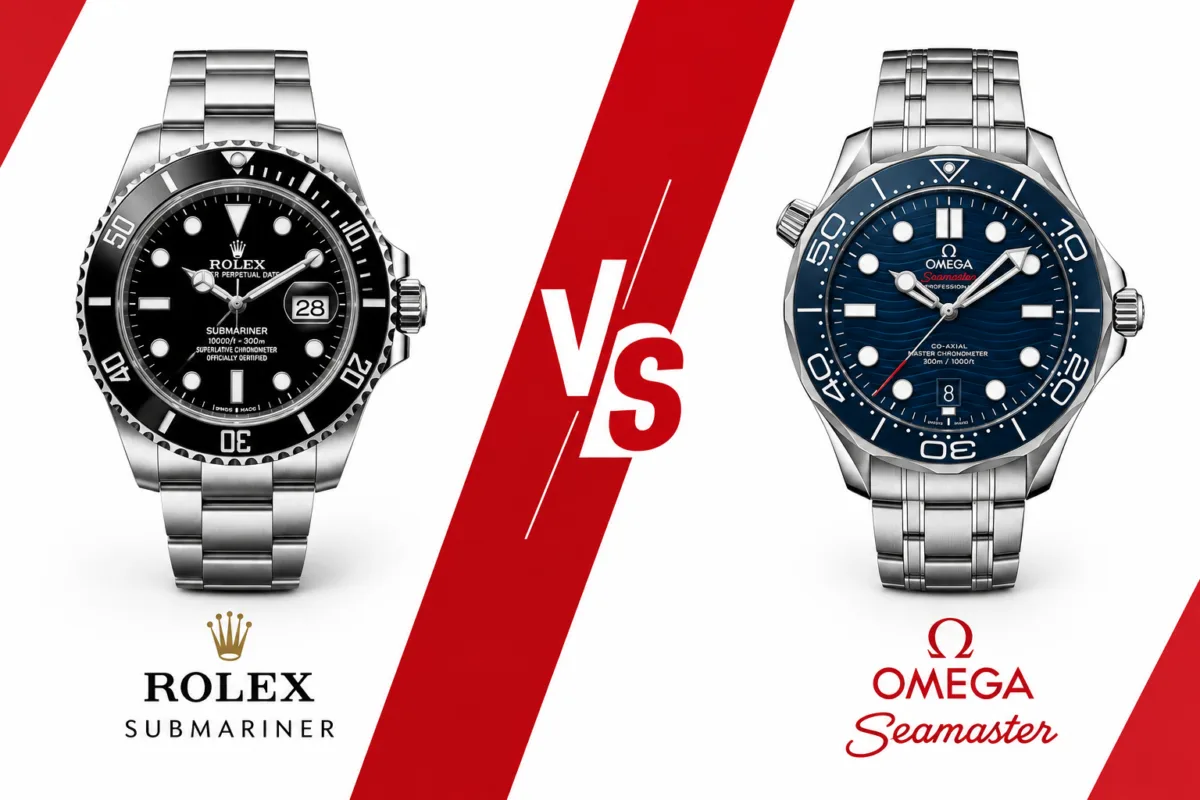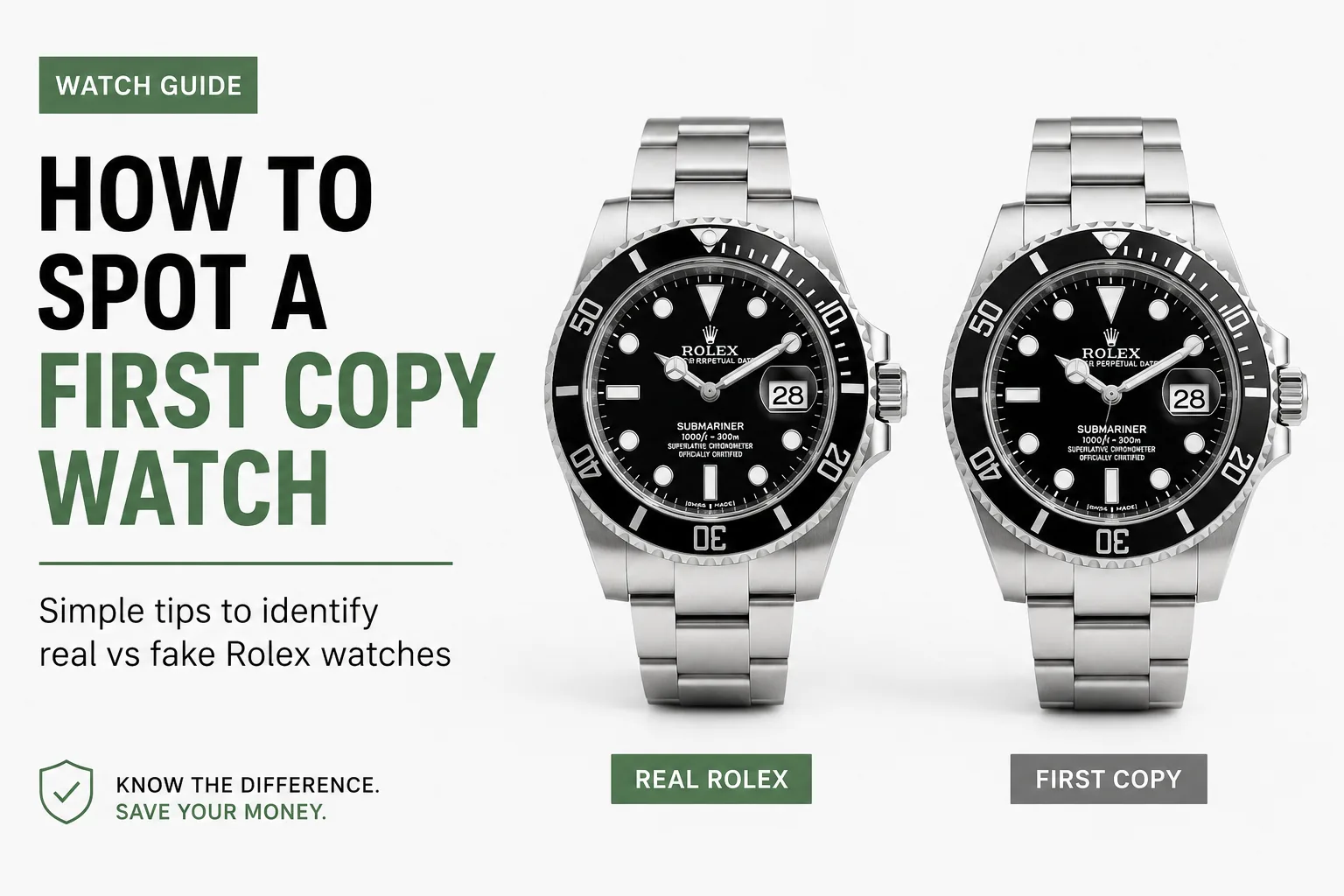
- First copy watches look nearly identical to originals but use different internal components
- Quality has improved massively — today’s first copy watches closely rival originals in appearance
- The biggest differences are in crown mechanism, drop resistance, movement longevity, and finishing under magnification
- Handle first copy watches more carefully — especially around the crown and from heights
- Accuracy-wise, good first copy watches perform at ±45 seconds per 24 hours — same as many genuine affordable watches
What Is A First Copy Watch?
A first copy watch is a replica timepiece designed to look exactly like a luxury original brands like Rolex, Omega, Hublot, Tag Heuer, and Audemars Piguet but manufactured using different internal components at a fraction of the original price.
The term “first copy” is widely used in India to describe the highest-quality tier of replica watches. Unlike low-grade fakes, first copy watches are built to closely mirror the aesthetic of their originals — the case shape, dial design, bezel, bracelet, and finishing all replicate the genuine article with impressive precision.
What separates a first copy from an original is not what you can easily see — it’s what’s inside. The movement, materials, and build tolerance are different. This is important to understand before you buy, and essential knowledge if you want to spot the difference.
First Copy vs Original — The Visual Difference
Here’s the honest truth: the visual difference between a good first copy watch and an original is surprisingly small.
Today’s first copy watches have reached a quality level where even experienced buyers need to look closely — very closely — to spot differences. Side by side with the original, you’ll find:
| Feature | Original Watch | First Copy Watch |
| Case shape | Perfect, machine-cut | Very close, minor variance |
| Dial printing | Laser-sharp, crisp fonts | Very good, minor blurring under 10x magnification |
| Logo engraving | Deep, precise | Present, slightly shallower |
| Bracelet finishing | Brushed + polished sections | Good finish, minor inconsistency at links |
| Crystal clarity | Sapphire, near-zero reflection | Mineral or sapphire-grade, slight reflection |
| Weight | Precise for the model | Close, sometimes slightly lighter |
| Caseback engraving | Perfect depth | Present, slightly different depth |
The gap has narrowed considerably. First copy watches available in India today — particularly the 7AA and 7AAA grades — deliver looks that are genuinely competitive with originals from a normal viewing distance.
How To Spot A First Copy Watch: 8 Key Checks
If you want to identify whether a watch is a first copy or original, run through these eight checks systematically.
1. Check the Dial Printing Under Magnification
Use a 10x loupe or your phone’s macro camera. On genuine luxury watches, every letter on the dial is perfectly formed — sharp edges, consistent font weight, zero bleeding. On first copy watches, you’ll often see:
- Slightly fuzzy edges on text under high magnification
- Minor colour inconsistency on multi-tone dials
- Sub-dial text that is slightly less crisp at the edges
At normal viewing distance? You won’t notice. Under a loupe? The original wins every time.
2. Feel the Crown
This is the single most reliable physical test for a first copy watch. The crown is where the quality difference is most obvious.
On a genuine Rolex or Omega, the crown screws down with smooth, precise resistance and a satisfying click. On first copy watches, the crown often:
- Feels slightly looser or grittier when screwing down
- Requires more care when pulling out to set the time
- Lacks the same precise resistance feel as the original
More importantly, the internal gear mechanism connected to the crown in a first copy watch is more delicate. Use it gently. This is covered in detail in the section below.
3. Listen to the Seconds Hand
On a genuine mechanical or automatic watch, the seconds hand sweeps smoothly — because the balance wheel oscillates at 6–10 beats per second. On a first copy mechanical watch, the sweep should also be smooth if the movement is working correctly.
On a quartz first copy watch, the seconds hand ticks — one step per second. If a watch is being sold as an “automatic” but the seconds hand ticks, it’s either a quartz movement or the automatic rotor isn’t working.
4. Check the Caseback
Genuine luxury watches have casebacks with precise, deeply engraved serial numbers, model references, and hallmarks. On first copy watches:
- Engravings are usually present but may be shallower
- Serial numbers won’t match any genuine watch database (e.g., Rolex Check)
- “Swiss Made” engravings on non-Swiss-movement watches are a giveaway
Flip the watch over and compare to official images from the brand’s website.
5. Weigh It
Original Rolex, Hublot, and Omega watches have a very specific weight because they use solid 904L stainless steel or 316L steel with thick cases. First copy watches are often slightly lighter because:
- Thinner steel is used for the case
- Internal components weigh less
- Bracelet links may be hollow rather than solid
A 10–20 gram difference from the official specification is a reliable indicator. Check the official weight spec online and compare.
6. Check the Bracelet Link Finishing
On genuine watches, the bracelet alternates between brushed and polished surfaces on individual links — a manufacturing process that requires precision tooling. On first copy watches:
- The distinction between brushed and polished sections is less defined
- Link edges may have minor burrs if you run your fingernail along them
- Clasp mechanisms open and close with less precision
This check is especially effective on Rolex Oyster bracelets, AP Royal Oak integrated bracelets, and Cartier Panther bracelets.
7. Run the 24-Hour Accuracy Test
For mechanical and automatic watches, accuracy is measurable. Place the watch on a flat surface crown-up for 24 hours after setting the time precisely. Then check:
- Original luxury watches: ±5 seconds per day (COSC-certified movements)
- Good first copy watches: ±45 seconds per day
- Poor quality first copy watches: 2+ minutes per day
A variation of more than 2 minutes in 24 hours suggests a low-grade or poorly regulated movement. A good first copy watch with a Japanese Miyota or Chinese clone movement will typically run within ±30–45 seconds — acceptable performance for everyday use.
8. Check Holographic Stickers and Documentation
Every genuine luxury watch ships with:
- A certificate of authenticity with a matching serial number
- A manufacturer’s warranty card
- Brand-specific holographic stickers or security seals on the caseback
First copy watches may come with generic documentation, but serial numbers won’t verify through brand databases. Rolex, Omega, and Tag Heuer all allow serial number checks through their official websites or authorised dealers.
Movement Quality — What’s Really Different Inside
This is the most important thing to understand about first copy watches, and it’s the core reason why they’re priced so differently from originals.
The movement — the engine of a watch — determines accuracy, longevity, and reliability. Here’s what’s happening inside different watch tiers:
Original luxury watch movements (e.g., Rolex Caliber 3235, Omega Co-Axial 8800):
- Manufactured in-house to tolerances of microns
- COSC-certified accuracy of ±4 seconds per day
- Servicing interval of 5–10 years
- Service life of 30–50+ years with proper care
- Shock-resistant to 5,000 Gs (Rolex Parachrom hairspring)
First copy watch movements (Japanese Miyota, Chinese ST/clone movements):
- Factory-produced movements originally designed for affordable non-replica watches
- Accuracy of ±30–45 seconds per 24 hours — perfectly usable daily
- More delicate than originals — vulnerable to drops and rough crown use
- Longevity depends heavily on how carefully you use and store the watch
- Cannot be serviced as easily as original movements
Interestingly, the same movements used in first copy watches are also used in genuine budget mechanical watches from lesser-known brands. The performance is real — the issue is durability under stress.
The Crown Test — The Easiest Way To Tell
The crown is the most revealing test for a first copy watch.
When you pull out the crown on an original luxury watch to set the time, you feel:
- Precise, defined click positions (position 1 for date, position 2 for time)
- Smooth resistance as you rotate
- No wobble or play in the crown shaft
On a first copy watch, you should still feel the click positions — but the resistance feels different. More importantly, the internal gear connecting the crown to the movement is the most fragile component in a first copy watch.
This is not a flaw unique to replicas — it’s a function of manufacturing tolerance. The message is practical: when setting the time on a first copy watch, be gentle. Don’t yank the crown, don’t force it, and push it back in carefully. Many first copy watch owners who report their watch “stopping working” have damaged the crown mechanism through rough use — not through normal daily wear.
Drop Test Difference — Why This Matters
This is perhaps the single biggest functional difference between an original watch and a first copy.
If you drop an original Rolex from waist height, there is very little chance it stops working. Rolex uses a Parachrom hairspring that is specifically designed to absorb shock. Omega’s Co-Axial movements are similarly shock-protected.
If you drop a first copy watch from the same height, the movement may stop working entirely.
The internal movement in a first copy watch — while accurate and reliable under normal use — has components that are not shock-mounted to the same standard. A fall can physically displace the balance wheel, shift the gear train, or knock the rotor off its bearing.
This is not a reason to avoid first copy watches. It is a reason to:
- Not wear your first copy watch during physical work or sport
- Be careful when removing it over a hard bathroom counter
- Store it in a watch box or pouch when not wearing it
Think of it the way you’d think about a budget smartphone vs a flagship. The budget phone works perfectly — but it won’t survive a 2-metre drop on concrete the way a flagship might.
Accuracy Check — 24-Hour Timing Test
If you want a definitive measurement of whether your watch is performing well, run the 24-hour timing test.
How to do it:
- Set your watch to the exact time using your phone
- Place it crown-side up on a flat surface
- Don’t disturb it for 24 hours
- After 24 hours, compare the watch time to your phone
What the results mean:
| Variance in 24 hours | What it tells you |
| ±5 seconds | Excellent — original luxury movement quality |
| ±15 seconds | Very good — well-regulated movement |
| ±30–45 seconds | Good — standard first copy quality, perfectly usable |
| ±2 minutes | Below average — movement needs regulation |
| 5+ minutes | Poor — low-grade movement or needs service |
Most good first copy watches — particularly those with Miyota 8215 or clone ETA movements — will land in the ±30–45 second range. This is the same standard that the Swiss standard for non-COSC certified watches uses as acceptable.
Is A First Copy Watch Worth Buying?
This depends entirely on your priorities and budget. Here is an honest breakdown:
First copy watches make sense if:
- You want the look of a luxury watch without the luxury price
- Your budget is under ₹7,000 and you accept the trade-offs
- You are style-conscious but don’t need the resale value or heritage of an original
- You travel frequently and prefer not to risk an expensive original being lost or stolen
There is actually a real advantage to a first copy watch if it gets stolen — the thief doesn’t know they’ve gone to considerable effort for something worth a few hundred rupees. With a genuine Rolex, the loss is devastating. With a first copy, you replace it.
Original watches make more sense if:
- You have the budget to spend comfortably
- You want a long-term investment — original luxury watches appreciate in value
- You want to pass something down or resell at full value
- You want the movement serviced and a full warranty
The honest verdict: First copy watches deliver genuinely impressive value for their price. If you handle them with care — gentle with the crown, careful about drops, stored properly — a good first copy watch can last for years. Some owners have worn the same first copy watch for 3–5 years with no issues. The key word is care.
How To Buy A Good First Copy Watch
If you’ve decided a first copy watch is right for you, here’s how to make sure you’re getting a good one.
- Check the movement and accuracy first. Before committing, ask if you can run a 24-hour test or ask the seller for accuracy data.
- Look for a live video call option. Reputable first copy watch sellers in India — including Premium Watch Store — offer live WhatsApp video verification before dispatch so you can see the actual watch before it arrives.
- Understand the quality grades. Quality varies significantly:
- 7A: Entry level — looks good, basic movement
- 7AA: Mid tier — better finishing, reliable daily movement
- 7AAA: High tier — closest to original in finishing and movement quality
- Super Clone / Master Copy: Closest available to original in overall quality
- Check return and warranty policies. A trustworthy seller should offer a return window and at least basic after-sales support.
- Buy from a seller with real reviews. Verified reviews, video testimonials, and a track record matter when you can’t physically inspect the watch.
FAQs
Q: Can you tell a first copy watch from an original just by looking at it?
At normal viewing distance, a high-quality first copy watch (7AAA or super clone grade) is extremely difficult to distinguish from an original with the naked eye. Under 10x magnification or with side-by-side comparison, differences in dial printing, crown feel, and bracelet finishing become noticeable.
Q: How long does a first copy watch last?
With careful use — gentle crown handling, no drops, proper storage — a good first copy watch can last 2–5 years or more. The movement is the limiting factor. Users who treat their first copy watch roughly may find it stops within months. Users who treat it well can get years of reliable service.
Q: What is the difference between 7AA and 7AAA first copy watches?
7AA is a mid-tier grade featuring good finishing and a reliable movement. 7AAA represents a higher quality tier — closer to the original in case finishing, bracelet quality, and movement regulation. Super clone and master copy grades sit above both, using higher-specification movements and closer tolerances on all components.
Q: Do first copy watches have the same weight as originals?
Usually not exactly. Most first copy watches are 10–20 grams lighter than their genuine counterparts because they use thinner steel cases and lighter bracelets. Some super clone versions use heavier steel to more closely match original specifications.
Q: Is it safe to wear a first copy watch in the rain or while washing hands?
Most first copy watches have basic water resistance of 30m, which means splash and rain resistance is generally fine. However, do not submerge them, swim with them, or shower while wearing them — unlike genuine dive watches, the water resistance on first copy watches is not rigorously tested or certified.
Q: What brands are most commonly available as first copy watches in India?
The most popular first copy watch brands available in India include Rolex, Omega, Hublot, Tag Heuer, Audemars Piguet, Patek Philippe, Cartier, Tissot, Emporio Armani, Michael Kors, Versace, Fossil, G-Shock, and many more.
Conclusion
Spotting a first copy watch comes down to knowing where to look. The crown, the caseback engraving depth, the dial printing under magnification, and the 24-hour accuracy test are your four most reliable tools. At face value, today’s first copy watches are genuinely impressive — the quality has reached a level where the casual observer will never know the difference.
What separates a first copy from an original ultimately lives inside the case. The movement is more delicate, less shock-resistant, and has a shorter service life. But for buyers who want luxury aesthetics at an accessible price — and who handle their watches with care — a good first copy watch is absolutely a practical, stylish, and enjoyable choice.
If you’re looking to buy first copy watches in India with live video verification, cash on delivery, and a genuine quality guarantee, explore our full collection at Premium Watch Store.