What Is An Automatic Watch Crown?
I’ve sold and handled hundreds of automatic watches over the past several years — Rolex-inspired first copies, genuine Tissot, Casio Edifice mechanicals, and everything in between. And the single question I get most on WhatsApp before a customer even places their order is this: “Bhai, how do I set the time?”
It sounds simple. But if you’ve never owned a mechanical or automatic watch before — especially if you’re coming from a quartz or smartwatch — the crown mechanism feels unfamiliar and a little intimidating. Get it wrong and you risk damaging the most delicate part of the watch.
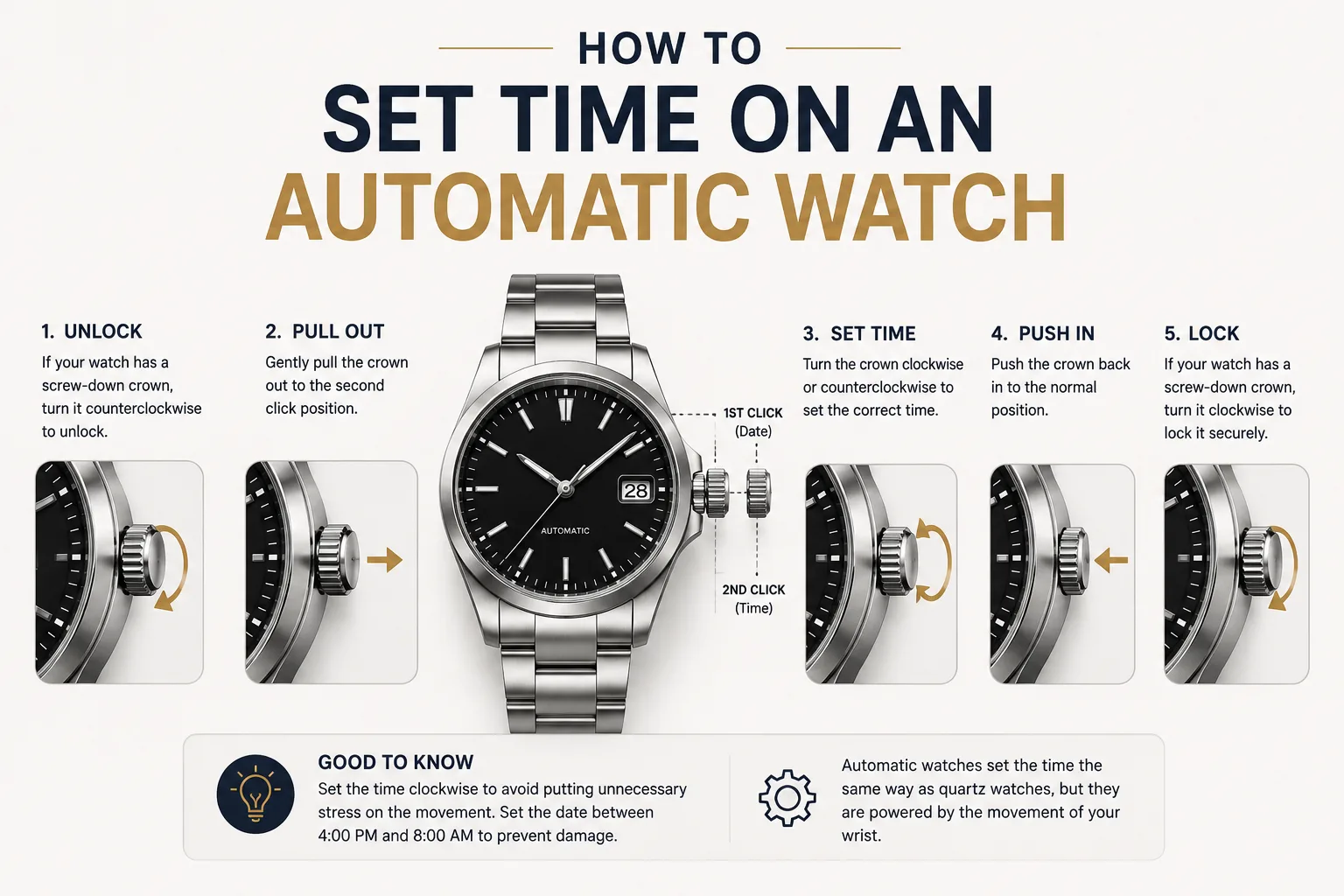
The crown is the small knob on the right side of the watch case, usually at the 3 o’clock position. On automatic watches, it serves three functions depending on how far you pull it out — winding the mainspring, setting the date, and setting the time. On a screw-down crown (like most Rolex Submariner-inspired designs), you first need to unscrew it counter-clockwise before pulling it out at all.
The 3 Crown Positions Explained
Every automatic watch I’ve ever handled uses the same three-position crown system. Understanding this is the foundation of everything else.
Position 0 — Crown fully pushed in (home position)
This is where the crown sits during normal wear. On screw-down crowns, it’s screwed flush against the case. In position 0, rotating the crown winds the mainspring manually. This charges the power reserve — typically 38 to 80 hours depending on the movement.
Position 1 — Crown pulled out one click
One gentle pull and you feel a soft click. This is the date-setting position. Rotating the crown at position 1 advances the date display. On watches with a day-date complication (like Rolex Day-Date-inspired first copies), rotating forward changes the date and rotating backward changes the day.
Position 2 — Crown pulled out fully (two clicks)
This is the time-setting position. The seconds hand stops completely — this is called “hacking,” and it lets you synchronise the time precisely. Rotate the crown clockwise to move the hands forward. Never rotate the time-setting crown backward aggressively on a first copy watch — always go forward.
How To Set Time — Step By Step
Here’s the exact process I walk every customer through when they receive their watch:
Step 1 — Unscrew the crown (if screw-down)
Hold the case firmly and rotate the crown counter-clockwise with your thumb and index finger. You’ll feel it loosen after 3–4 turns. Don’t pull yet — just unscrew until it’s free.
Step 2 — Pull the crown to position 2
Two gentle pulls outward. The seconds hand will stop. This confirms the movement is responding correctly and gives you a precise starting point.
Step 3 — Check your reference time
Have your phone or another accurate clock ready before rotating. Don’t start spinning the crown and then look for your phone — you’ll lose count.
Step 4 — Rotate clockwise to set the time
Turn the crown clockwise to advance the hands. Move past your target time by about 2 minutes, then come back forward to the exact second. This takes up any gear backlash and gives you a more accurate set.
Step 5 — Sync to the second
When your reference clock is about 5 seconds from the target time, push the crown back to position 0 exactly as the seconds hit 0. The seconds hand starts sweeping again. You’re set.
Step 6 — Screw the crown back down
On screw-down crowns, push the crown gently inward while rotating clockwise until you feel it bite. Then tighten 2–3 turns. Don’t overtighten — you’ll damage the crown tube over time.
How To Set The Date Correctly
This is where I see the most mistakes — and on first copy watches specifically, getting this wrong can damage the date mechanism permanently.
The golden rule: never set the date when the hour hand is between 10 PM and 2 AM.
Here’s why. Inside the movement, the date-change mechanism is engaged and mid-cycle during this 4-hour window. Forcing the date wheel while it’s already trying to advance can strip the date gears — and on a first copy watch, that part is very hard to service.
My process:
- First use position 2 to move the hour hand to somewhere between 8 AM and 4 PM — comfortably away from midnight.
- Push the crown back to position 1.
- Rotate the crown to advance the date to yesterday’s date.
- Move back to position 2, advance the hour hand through 12 midnight — you’ll see the date change automatically.
- If you need to advance more, push back to position 1 and keep going.
This sounds like extra steps. But after seeing a cracked date wheel on a ₹3,000 automatic first copy that a customer forced at midnight, I always take the extra 60 seconds.
How To Wind An Automatic Watch By Hand
If your automatic watch has been sitting unworn for more than 48 hours, the mainspring will have run down completely. Before setting the time, you need to give it power.
From position 0, rotate the crown clockwise — this is the winding direction. You’ll feel a slight resistance with each turn. Give it 25 to 30 full rotations. You don’t need to count precisely, but 20 is the minimum to get the movement running reliably.
On an automatic watch, the rotor (the half-moon weight inside the case) winds the spring through wrist movement during normal wear. So once you’ve set the time and put the watch on, it should stay running indefinitely as long as you wear it for at least 8–10 hours per day.
According to Miyota’s published specifications for their 8215 movement — the most common movement in quality first copy and budget automatic watches — the power reserve after full winding is 42 hours. ETA 2824-based movements (used in originals like Tissot T-Classic) offer up to 80 hours.
Common Mistakes I See Every Week
After handling hundreds of customer queries, these are the mistakes I see most often:
1. Pulling the crown too hard
The crown detents are delicate. Pull slowly and feel for the click. Yanking it damages the stem.
2. Setting time backward on first copy watches
Always go forward (clockwise at position 2). On an original Rolex or Omega, the movement tolerates backward rotation. On most first copy movements, the keyless works aren’t built to the same tolerance — forcing backward can strip the time-setting gears.
3. Forgetting to push the crown back in
If the crown stays at position 2, the seconds hand doesn’t move — the watch isn’t running. I’ve had customers call me saying “the watch stopped working” when they’d simply left the crown pulled out.
4. Setting the date at midnight
Covered above — this is the one that causes real damage. Never touch the date setting when the hour hand is near 12.
5. Overtightening the screw-down crown
Two to three turns clockwise after pushing in is enough. Any more and you’re stressing the crown tube gasket — which affects water resistance and can eventually crack the tube.
First Copy vs Original — Does Setting Work The Same?
Largely yes — the crown position system is identical. The difference is in feel and durability.
On a genuine Rolex Submariner, the crown screws down with a satisfying, precise resistance. The internal gears engage with zero play. On a 7AA or 7AAA first copy, the mechanism works exactly the same way — pull to position 1 for date, position 2 for time — but the crown action feels slightly softer, sometimes with a little more play.
The key practical difference is this: on first copy watches, be gentler. The mainspring and gear train are real mechanical components — they work — but the tolerances are wider than Swiss manufacture. Gentle, deliberate crown use extends the life of the movement significantly. I’ve seen customers wear the same first copy automatic for 3–4 years with zero issues because they treat it carefully. And I’ve seen identical watches fail in 3 months from rough use.
All automatic watches we sell at Premium Watch Store come set to the correct time before dispatch. But after transit, the time will have drifted — which is why knowing this process matters.
FAQ
Q: How do I know which direction to turn the crown to set time? Always rotate clockwise (forward) to advance the time. This moves the hands in the correct direction and avoids any risk of damaging the time-setting mechanism, which is particularly important on first copy and budget automatic watches where the gear tolerances are wider than on original Swiss movements.
Q: My automatic watch stopped. What do I do first? Wind the crown 25–30 turns clockwise from position 0 before doing anything else. If the watch still doesn’t start sweeping after winding, try shaking the watch gently — the rotor needs movement to confirm the mainspring has engaged. If it still doesn’t run, the movement may need service.
Q: Can I set the time on a screw-down crown without unscrewing it? No — and trying to do so will damage the crown tube. You must unscrew the crown fully (counter-clockwise, 3–4 turns) before pulling it to position 1 or 2. This is a common mistake on Submariner-style first copy watches.
Q: Why does the seconds hand stop when I pull the crown to position 2? This is called the “hacking” feature — a small lever inside the movement presses against the balance wheel to stop it, giving you a precise time-setting reference. Not all movements have this — some older or very budget movements don’t hack, meaning the seconds hand keeps running even at position 2.
Q: How accurate should my automatic watch be? The standard tolerance for a regulated automatic movement is ±45 seconds per day. Swiss COSC certification requires ±4 seconds per day for genuine luxury movements. Most quality first copy watches with Miyota or Chinese clone movements run within ±30 seconds per day — more than acceptable for everyday use.
Q: Does wearing the watch charge it automatically? Yes — this is the defining feature of an automatic watch. The rotor inside the case spins with your wrist movement, winding the mainspring continuously. As long as you wear the watch for 8–10 hours daily, it should never need manual winding during normal use.
Conclusion
Setting time on an automatic watch takes about 2 minutes once you know the three crown positions. The most important things to remember: unscrew before pulling on a screw-down crown, always go clockwise when setting time, wind 25 turns before setting if the watch has stopped, and never touch the date near midnight.
If you’ve just received your watch from us and need help setting it — WhatsApp us at +91 9326380670. We walk every customer through the process live on video call, the same way we verify the watch before dispatch.
Author Bio
Written by the Premium Watch Store team, Mumbai We’ve sold and personally inspected 500+ automatic watches — from budget Japanese Miyota movements to ETA-based Swiss-grade first copies. Every watch we describe on this site we’ve held, set, and checked for accuracy before writing about it. Questions? WhatsApp us directly at +91 9326380670.